
You’ve come to the correct place if you can’t start your day without a warm cup of espresso.
Table Of Contents
−- Reviews of the Top 13 Best Espresso Machines
- #1. Breville, the Barista Express Semi-Automatic Espresso Machine, is the best overall espresso machine.
- #2. Rancilio Silvia is the best home espresso machine.
- #3. Breville Oracle Touch Fully Automatic Espresso Machine is the best super-automatic espresso machine.
- #4. Mr. Coffee Cafe Barista Espresso and Cappuccino Maker is the best value.
- #5. Flair Espresso Maker Manual
- #6. De’Longhi VertuoPlus Coffee and Espresso Machine is the best pod.
- #7. Keurig K-Cafe Coffee Maker is the best single-serve coffee maker.
- #8. Breville Duo Temp Pro Espresso Machine is the best coffee and espresso machine combo.
- #9. Breville BES500BSS Bambino Plus is the best espresso machine for beginners.
- #10. Budget-friendly option: De’Longhi Bar Pump Espresso and Cappuccino Maker
- #11. SOWTECH 3.5 Bar Espresso Machine is the best espresso machine under $100.
- #12. Breville, the Barista Pro Automatic Espresso Machine, is the most customizable.
- #13. Best Commercial: La Pavoni BAR-T 2V-B
- The components of an espresso machine
- How Do I Select the Best Espresso Machine?
- How does an espresso machine work?
- What kinds of espresso machines exist?

We’ve compiled a list of the best espresso machines, so you don’t have to rush to the coffee shop every morning.
However, evaluations may only be of assistance if you have a fundamental grasp of espresso machines. Buying the appropriate espresso machine necessitates an awareness of how an espresso machine works as well as some key features to look for.
Everything is covered in depth in our thorough best espresso machine reviews and guide, so keep reading!
Reviews of the Top 13 Best Espresso Machines
Let’s get into the list below and go through our best espresso makers.
#1. Breville, the Barista Express Semi-Automatic Espresso Machine, is the best overall espresso machine.
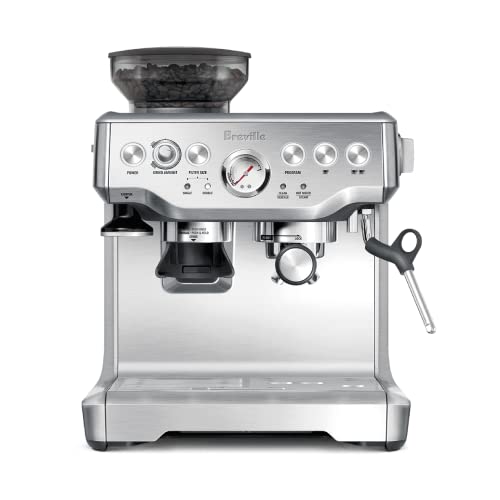
- The Breville Barista Express delivers third wave specialty coffee at home using the 4 keys formula and is...
- DOSE CONTROL GRINDING: Integrated precision conical burr grinder grinds on demand to deliver the right...
- OPTIMAL WATER PRESSURE: Low pressure pre-infusion gradually increases pressure at the start and helps...
This semi-automatic beauty may be a fantastic choice if you’re looking for the ‘ideal’ espresso shot to start your day.
The Breville Barista Express has enough automation to make espresso-making a breeze. On the other hand, it provides you with fine-grained control over several variables, such as temperature, through the use of PID.
To begin, it grinds your beans precisely as you want them with its conical burr grinder, which has 18 settings ranging from ‘coarse’ to ‘fine.’
It also dumps the ground coffee directly into the portafilter, which is pure delight. As a result, you’ll frequently discover coffee grounds in the drip tray, which adds to the machine’s upkeep.
Aside from that, it’s rather large, holding 8.8 oz of coffee and 2.1 gallons of water. However, this results in a 13.5-inch broad construction that takes up a lot of counter space.
The single group head maker has 15 pressure bars to satisfy every taste bud. With a mid-to-high price range, it also comes with a slew of extras, like a built-in tamper, a hot water dispenser for your americanos, a cleaning warning light, and much more.
Pros
- PID temperature control is used in digital temperature control.
- Integrated coffee grinder and tamper
- There are 18 grind settings.
- Energy-saving
- Attractive stainless steel exterior
- Large water storage tank
Cons
- It needs a great deal of upkeep.
#2. Rancilio Silvia is the best home espresso machine.
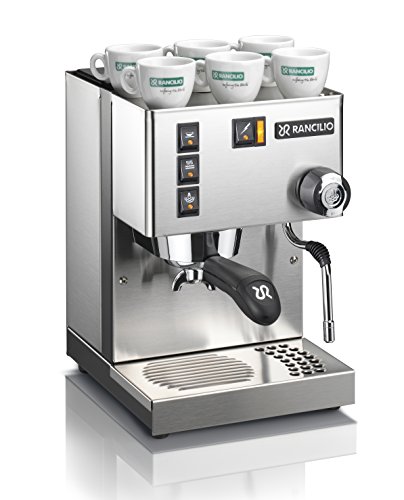
- Ergonomic porta filter handle same as the proven design of Rancilio commercial machines
- Commercial grade group head for superb heat stability and extraction quality
- Articulating steam wand offers complete range of motion and professional steaming knob precisely controls...
In our opinion, the Rancilio Silvia espresso machine is best suited for experienced users. Even better, it’s ideal for the former barista to use commercial machines or perform most of the tasks manually to generate diverse flavors.
This manufacturer’s durability is an important attribute. It has a stainless steel body, including the frothing wand, making it durable and visually appealing.
Furthermore, the single boiler is made of brass, which is known to assist retain heat. However, keep in mind that a single boiler isn’t ideal for temperature control. Therefore this is only recommended for experienced users. This is exacerbated by the absence of a pressure gauge.
When you handle the portafilter, you’ll note that it’s nice and weighty thanks to its chrome-plated brass construction and is made to last. Another advantage is the 3-way valve, which reduces pressure as soon as you turn off the brewing, preventing hot water from blasting out.
The Rancilio Silvia is one of the finest home espresso machines for veterans, with a capacious 2.1-quart tank and a robust 15-bar pump. It’s even comparable to a professional-grade commercial maker.
Pros
- For durability, the exterior is made of stainless steel.
- Brass boiler and group head
- The 3-way valve keeps portafilters clean.
- 15 psi pump
- a big tank
Cons
- For novices, it might be a little tricky to use.
#3. Breville Oracle Touch Fully Automatic Espresso Machine is the best super-automatic espresso machine.
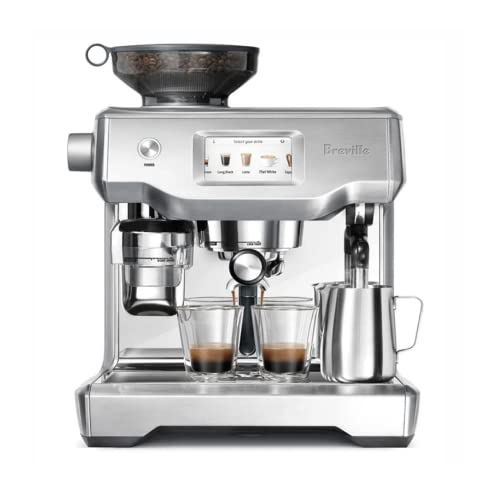
- The Breville Oracle Touch with touch screen delivers third wave specialty coffee at home using the 4 keys...
- DOSE CONTROL GRINDING: The integrated precision conical burr grinder automatically grinds, doses and...
- OPTIMAL WATER PRESSURE: The Over Pressure Valve limits the maximum pump pressure throughout extraction,...
We recommend the Breville Oracle Touch if you have the money but not the time to pull off the perfect shot at home. You’re only a touch away from a drink of your choosing with this super-automatic maker’s 4-inch touch screen.
Everything is automated using the Oracle Touch. Seriously. The capacitive touch screen allows you to configure every stage of the process, from grinding and tamping to brewing and frothing milk. You can also set the machine to turn on automatically so that you may enjoy a steaming hot shot anytime you choose.
The intelligent machine also remembers your preferences and allows you to keep many bespoke drink mixes in its memory. As a result, owing to its mechanical characteristics, you’ll get the identical flavor every time you pick that drink.
Furthermore, you can personalize everything, including dose, shot volume and timing, and grinding (with 45 possibilities). It even includes a cutting-edge steaming wand that cleans itself after use — talk about cutting-edge!
However, automation isn’t the only advantage of this espresso machine. It’s extremely sturdy, thanks to its stainless steel exterior and boiler. It also appears to be ultramodern and appealing.
The machine, however, is rather huge, being 15 inches broad. And, of course, all of this comes at an exorbitant cost. But, in all honesty, it’s a wise purchase, especially because it comes with a 2-year repair warranty, making it one of the best super automated espresso machines on the market.
Pros
- The boiler is made of stainless steel, as is the exterior.
- 4-inch touch-screen display
- Auto-power
- 45 different grinding possibilities
- Temperature probe and wand for auto-aeration
Cons
- a big size
- Extremely costly
#4. Mr. Coffee Cafe Barista Espresso and Cappuccino Maker is the best value.
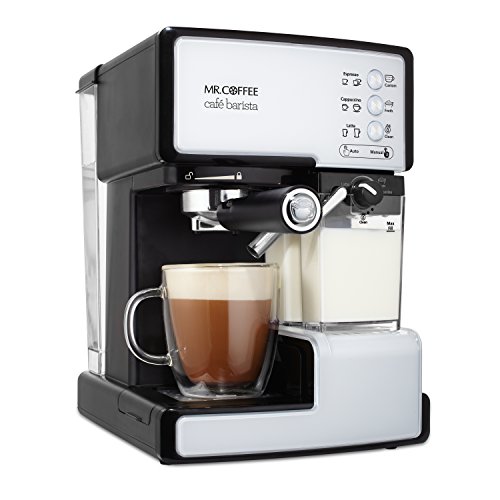
- Semi-automatic 3-in-1 espresso maker, cappuccino maker, and latte maker
- 15-bar pump system brews rich-tasting espresso coffee.
- Trouble-free automatic milk frother removes the guesswork
You don’t have to spend hundreds of dollars to experience the benefits of an espresso machine. The best affordable espresso machine on our list is the Mr. Coffee Barista Espresso machine. It’s not fully automated – you’ll still need to grind and tamp your beans – but it takes care of the rest.
The front of the machine includes three buttons for creating espressos, lattes, or cappuccinos. Double-pressing the buttons activates various functionalities, such as drawing a double shot. While this may appear confusing to some, we believe it simplifies the overall architecture of the machine.
After grinding and tamping the beans (with the provided plastic tamper), all that remains is to attach the portafilter, hit the selected drink button, and let the machine do the rest.
The machine froths the milk from the detachable milk reservoir and pours it into your cup for lattes and cappuccinos. However, the amount of milk for each drink is fixed, although you may change the frothing settings.
While the automated procedures make your life easier, you shouldn’t anticipate consistent shots from this equipment all of the time. After all, it’s not exactly pricey. However, we believe it is ideal for milk-based beverages that may disguise these irregularities.
Pros
- Milk frothing and distributing machines that work automatically
- With the push of a button, you may make a variety of drinks.
- Pump with a 15 bar pressure
- Water and milk reservoirs are detachable.
- Very simple to use
- Inexpensive
Cons
- Inconsistent outcomes
- The plastic tamper is ineffective.
- Predetermined milk amounts
#5. Flair Espresso Maker Manual

- HANDCRAFT SHOTS OF ESPRESSO - With the Flair Espresso Maker, you have a complete manual espresso machine...
- FULLY MANUAL & COMPLETELY BEAUTIFUL – The Flair Classic is a 100% human-powered, direct lever espresso...
- ADVANCED & BEGINNER ESPRESSO BREWING – The relaunched Flair Classic comes with both our Bottomless...
Try the Flair Espresso Maker if you’re an expert at preparing espresso or if you don’t like the taste of espresso from automated machines. It’s a completely manual espresso machine that requires you to heat the water and draw the shots by hand.
It can generate up to 16 pressure bars, allowing you to create unique flavor profiles for each taste bud. Furthermore, it has a removable brew head that can be washed with the other components.
Because you must do everything yourself (from the start). It’s also constructed of steel and aluminum, so it’ll endure a long time.
All you baristas out there will enjoy honing your talents with this low-cost manual espresso maker.
Pros
- Durable steel and aluminum construction
- Produces 16 pressure bars
- Parts are detachable for easy maintenance.
- It includes a tamper and other equipment.
- Lightweight in comparison
Cons
- Not the simplest to use
#6. De’Longhi VertuoPlus Coffee and Espresso Machine is the best pod.

- SINGLE SERVE COFFEE MAKER: Single serve coffee or espresso at the touch of a button. Innovative programs...
- COFFEE FOR EVERY OCCASION: Brew better coffee at home with Nespresso's single serve coffee maker. Drink...
- VERSATILE POD COFFEE MAKER: Brew 4 different cup sizes at the touch of a button (5oz and 8oz coffee,...
With the Nespresso coffee and espresso machine, you may have coffee and espresso (or anything you choose) every morning with no effort.
This machine requires you to purchase coffee pods (roughly $1 apiece), and that’s pretty much it. Drop it into the machine, and the centrifugal force will brew some delicious coffee and send it directly to your cup. Is it simple to use? 10/10.
It generates some great crema without milk usage because of the 7000 RPM. In addition, you may select espresso and other crema beverages, and the machine will modify the brew parameters accordingly. This is feasible because the machine can scan the barcodes on the Nespresso capsules.
Furthermore, this may be the greatest small espresso machine because it is so small. It’s also not too expensive.
However, as appealing as it seems, there are a few downsides. For example, you can only use Nespresso capsules and the cups they provide. Furthermore, even though the used-pod container can now keep up to ten pods, getting rid of them is still a pain.
Aside from that, this machine can produce Barista-quality espresso and beverages because of the rich-tasting Nespresso capsules. You only need to order pods to get started with this machine; it’s that simple to utilize.
Pros
- Very simple to use
- It produces excellent espresso.
- Lightweight and compact
- There are five cup sizes available.
- The used-pod holder may hold up to ten pods.
Cons
- Only works with Nespresso capsules.
- Purchasing pods may not be simple for everyone.
#7. Keurig K-Cafe Coffee Maker is the best single-serve coffee maker.

- INCLUDED IN THE BOX: Keurig K-Cafe coffee, latte, and cappuccino maker, and dishwasher safe frother..Cord...
- COFFEE, LATTES & CAPPUCCINOS: Use any K-Cup pod to brew coffee, or make delicious lattes and cappuccinos....
- DISHWASHER SAFE FROTHER: Froth fresh milk, including skim, soy, and almond. The frother is dishwasher...
Another choice is the Keurig K-Cafe coffee machine if the thought of pods appeals to you. It may be used to make coffee, lattes, and other things. You can also brew espresso by pressing the “strong” button, but it won’t be genuine because this is a coffee machine.
If, on the other hand, you enjoy cappuccinos and lattes, you’re in luck. You may pick between latte and cappuccino settings, as well as a hot and cold drink, with its automated frother.
If you like cream, you’ll enjoy this machine since it froths out some great-looking crema to accompany your beverages. But the greatest thing is… The frother is dishwasher safe, and its contents may be simply stored in the fridge for subsequent use.
Furthermore, the machine can accommodate mugs up to six inches in diameter with the drip tray in place. Furthermore, its 60 oz reservoir can hold up to six cups of coffee, allowing you to stay alert throughout the day.
Some extra features help make this one of the best-rated espresso machines. For example, you may be reminded to descale your machine. It will also turn off automatically after two hours of use, saving energy. As a result, it’s a wise choice for folks searching for convenience.
Pros
- Large water storage tank
- Reminder to descale
- Automatic power off
- Simple to use
- frothing on its own
Cons
- Extremely wide(around 15 inches)
- It is not possible to brew ‘genuine’ espresso shots.
#8. Breville Duo Temp Pro Espresso Machine is the best coffee and espresso machine combo.
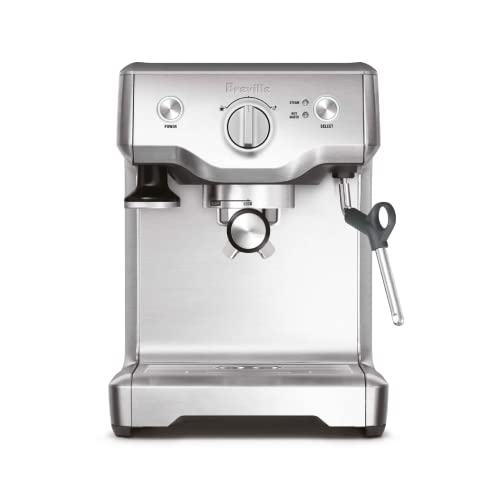
- The Breville Duo Temp Pro lets you create third wave specialty coffee at home; This espresso machine...
- PRECISE ESPRESSO EXTRACTION: Low pressure pre-infusion helps ensure all the flavors are drawn out evenly...
- WATER TEMPERATURE: The 1600W Thermocoil–Integrated stainless steel water path accurately controls water...
The Breville Duo Temp Pro is another amazing alternative for preparing the best coffee beverages and espressos without spending hundreds of dollars. It is not only simple to use, but it also comes with several accessories to provide a pleasant experience.
So, what exactly is the problem with Duo temp? The equipment has a single boiler, but because of this technology, you can steam and brew at various temperatures.
Because of the auto-purge feature, this is feasible. After steaming, flip the dial to drain the steam and mix in cool water, allowing you to begin brewing in seconds. It’s a fairly remarkable feature for a laptop in this price range.
It also includes an integrated PID that adjusts the temperature, allowing you to experience a perfect shot every time. It’s brew-ready in a matter of minutes, thanks to the stainless steel thermacoil. Oh, the steaming wand is also stainless steel, which is a plus.
All you have to do is grind your coffee, tamp it, and connect the portafilter. After pre-infusing, the machine draws the shots for you. It also features a tray-emptying indication. Underneath this is a storage area for additional tools. What a lovely gesture!
Overall, we think it’s a steal, especially with all of its extras.
Pros
- Stainless steel on the outside
- Temperature regulation PID
- Purge automatically for various brewing and boiling temperatures
- Pre-infusion
- Design that is straightforward and easy to utilize
- dispenser of hot water
Cons
- It’s tough to operate a rear-mounted reservoir.
#9. Breville BES500BSS Bambino Plus is the best espresso machine for beginners.

- The Breville Bambino Plus delivers third wave specialty coffee at home using the 4 keys formula and is...
- DOSE CONTROL GRINDING: Achieve a consistent and balanced espresso using the right amount of ground...
- OPTIMAL WATER PRESSURE: Low pressure pre-infusion gradually increases pressure at the start and helps...
Breville’s virtually automated espresso machine is a fantastic place to start for novices who are serious about their espressos. The Bambino Plus, a smart steam wand similar to the Oracle, provides excellent value for money.
The size is the first thing that stands out since it is only eight inches broad. However, because it lacks a built-in grinder, you may argue that a separate grinder renders the Bambino’s small design pointless.
On the other hand, the pressurized baskets let you use pre-ground coffee, which is ideal for novices. A 2.1-quart reservoir is included, as well as the capacity to accommodate a 5-inch tall cup on the drip tray.
Furthermore, the Bambino Plus uses PID temperature control to deliver consistent, delicious shots. It also has a quick heat mechanism to begin brewing in seconds.
Furthermore, the automated steam with customizable milk temperature and texture creates the ideal foam for latte art. As a result, the Bambino Plus is the greatest automated espresso machine (almost automatic) that is also reasonably priced.
Pros
- The exterior is brushed stainless steel.
- a substantial reservoir
- Heat for 3 seconds.
- Steam wand that works automatically
- Cost-effective
Cons
- There is no built-in grinder.
- The steaming wand has the potential to produce a sloppy mess.
#10. Budget-friendly option: De’Longhi Bar Pump Espresso and Cappuccino Maker

- Note: 1)Too coarse a grind, too little coffee, or insufficiently tamping the grounds before brewing can...
- EVERY CUP TO YOUR LIKING: 15-bar professional pressure assures quality results every time, and adjustable...
- BREW LIKE A PRO: Whatever your preference – single or double espresso, cappuccino or latte – the...
So, you don’t want to break the bank and only have a few hundred bucks to spare. The wise decision is to try Enter De’Longhi Bar Pump, the great espresso machine under $200 on our list.
It’s easy to operate, with only one dial for various settings like as resting, heating, brewing, and steaming. A second knob regulates the wand’s steam. The machine can hold a quart-sized tank, which is impressive given that it is only 10 inches tall and 7 inches broad.
This maker uses a single boiler and a twin thermostat to achieve the two different temperatures. However, you cannot anticipate regular outcomes, especially given the cost.
On the plus side, it has a 3-in-1 holder that can contain one shot, two shots, or an ESE pod. The machine also keeps the brewing temperature constant, so you won’t have to wait between shots. It’s also simple to clean, thanks to a replaceable water tank and stainless steel tray.
Pros
- Affordable
- Controls are simple.
- Simple upkeep
- Drip tray made of steel
- The footprint is really modest.
Cons
- Light roast grounds may be difficult to work with.
- Only fits 2-inch cups
#11. SOWTECH 3.5 Bar Espresso Machine is the best espresso machine under $100.

Do you think $200 is a lot of money? So, we have something under $100 for you: the SOWTECH espresso machine.
SOWTECH makes the entire procedure very simple. Apart from the obvious, you don’t have to do much with a single dial to manage steaming and brewing. Simply place the coffee grounds in the filter, tamp them, and attach. Within minutes, you’ll have one to four cups of freshly made espresso.
The little machine also has a steaming wand that produces enough froth. You also receive a bunch of extras, such as a handy carafe that can store four cups of espresso.
Yes, it won’t produce the best espresso, but for the price, it’s the best budget espresso machine available.
Pros
- Extremely affordable
- Very simple to use
- Several accessories are included.
- Extremely compact
- The exterior is stylish.
Cons
- Inconsistent outcomes
- It’s possible that you won’t get the best froth.
#12. Breville, the Barista Pro Automatic Espresso Machine, is the most customizable.
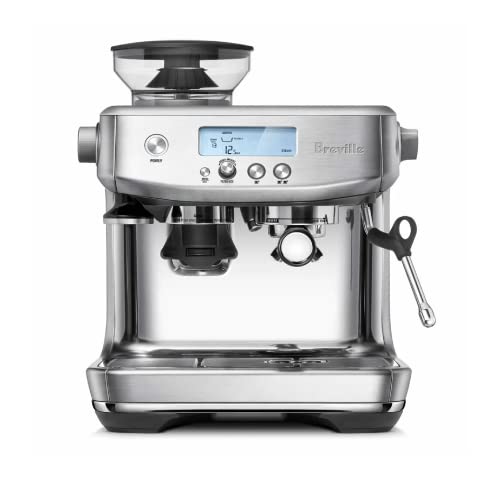
- Earn up to $200 cashback with a Beanz coffee subscription when you purchase a selected Breville espresso...
- The Breville Barista Pro delivers third wave specialty coffee at home with a single touch as the built in...
- Faster heat up time: Innovative ThermoJet heating system achieves the optimum extraction temperature in 3...
Do you know the difference between semi-automatic and automatic? The Barista Pro is the best espresso machine for home that is semi-automatic or automated, according to Breville.
If you don’t want to ground your own coffee beans, the machine’s built-in a conical burr grinder will. You may also modify it from a menu of 30 options on the digital screen. Not only that, but you can also customize your shoots’ temperature, volume, and timing.
Furthermore, because of its ThermoJet heating technology, the Barista Pro provides practically quick heat. It also has pressurized and non-pressurized baskets, so beginners won’t have to fight too much.
Because the machine does practically everything, all you have to do is froth the milk using the 360-degree rotating wand. All of this for less than a thousand dollars. Not too shabby.
Pros
- Conical burr grinder built-in
- There are several settings to choose from.
- It immediately heats up.
- 1 gallon huge tank
- Quickly transition from brew to steam
- dispenser of hot water
Cons
- Expensive
#13. Best Commercial: La Pavoni BAR-T 2V-B

- Groups made with press-forged brass and chrome plated, with vertical infusion chamber and pressurization...
- Boiler in copper equipped with transversal heat exchangers and front injectors for each group
- Independent radiator hydraulic system for every group
If you want to build a cafe or get into the espresso business, the La Pavoni BAR-T 2V-B is a fantastic place to start.
To begin with, it contains two brass group heads, which aid in heat retention. It also includes a big water tank that can hold liters of water to see you through the day.
With two steaming wands and independent solenoids, two persons may easily operate the unit simultaneously. Baristas can prepare some of the strongest and best-tasting espressos thanks to a vertical chamber for pre-infusion and convenience features like boiler auto-fill.
Pros
- There are several brass group leaders.
- Solenoids that operate independently
- Pre-infusion chamber that is vertical
- dispenser of hot water
- Vacuum-sealing valve
Cons
- Extremely heavy
- Important elements
The components of an espresso machine
The brew group, sometimes known as the brew head or simply “the group,” is where the actual brewing of coffee takes place. Hot water runs from the boiler (and any other heating components that may be employed), through the group, and into the portafilter, which houses the filter basket packed with tamped and finely ground roasted coffee and is locked into place beneath the group.
Group heads acquire coffee fines and oils over time. They must be cleaned regularly, either by disassembly or using a backflush plate/blank portafilter insert (provided with most machines) and detergent, such as URNEX Cafiza.
Portafilters
This is the handle-mounted cup-like container with a spout into which the coffee is ground before it is added to the group. It comprises a circular filter basket holder that holds the finely ground coffee and has small pinholes through which the brewed espresso shot flows into the dispensing spout. Portafilters (and filter baskets) are available in various sizes and standards, including the 58mm standard used on commercial equipment and numerous 54mm and other manufacturer-specific sizes.
Tamper
The tamper is used for tamping espresso grinds in the portafilter basket. Tamping permits grounds to be packed uniformly and thickly to provide enough resistance to achieve the proper pressure for a perfect espresso shot. Tampers can be calibrated (to restrict the compressive force given to the coffee grinds) or uncalibrated (for users who like to operate by feel). They can be flat or convex, depending on the barista’s choice.
With any machine that accepts a normal 58mm portafilter (or other common sizes such as Breville’s 54mm diameter), you’ll want to upgrade your tamper to something of higher quality at some point (such as the Espro or Decent, both calibrated). You’ll also need a leveling tool and a nude/bottomless portafilter to accommodate bigger baskets. Consider replacing the basket with a VST or similar professional laser-cut basket, especially if you desire more grams of coffee in your shot, as we do with an 18-gram or 22-gram basket.
Pump
The pump is the heart of the espresso machine, moving water via the piped circulatory system, heating elements, and exchange system into the group head. Most consumer espresso machines have a vibratory or “vibe” pump, which employs a piston connected to a magnet inside a metal coil. All the machines on this list employ vibratory pumps; more costly systems (so-called “prosumer” machines and professional ones priced at $2,500 and more) use quieter, bigger, and more dependable rotary pumps.
The electrical current flowing through the coil of a vibratory pump causes the magnet to drive the piston back and forth, propelling water through the machine at around sixty oscillations per second. A vibratory pump is a relatively cheap and standardized item (about $40) with a three-year lifetime, depending on the application. Along with valves and O-rings, the vibe pump is one of the most common components in an espresso machine that need repair.
If you want to use your machine frequently — preparing many espresso drinks per day — you should consider the expense and difficulties of repairing your espresso machine. Many of the high-end and traditionally designed intermediate machines we offer are meant to be readily repaired at home; if you aren’t confident in doing this basic repair yourself, a longer guarantee may be more essential to you. In the case of less-expensive machines, replacing a pump or other important component may be costly enough — maybe half the replacement cost — that you’ll choose to replace the machine entirely.
Thermoblocks and thermocoils
A thermoblock is a solid metal block with incorporated electrical circuits that heat water to brewing temperature (beginning at 195 degrees Fahrenheit) as it passes through a small path. They work similarly to tankless water heaters and are at the heart of every low-end espresso machine. They can be made of various materials, such as brass or aluminum, and there are variations with variable build quality and performance. A thermocoil operates similarly, heating water as it travels through a metal tube encircled by a coiled heating source.
The major benefit of utilizing a thermoblock or a thermocoil in an espresso machine over a boiler is that they can heat up rapidly. Some thermoblock-based machines are ready to draw shots as soon as they are turned on, whereas many older boiler designs require 15 minutes or more to reach the appropriate temperature.
Thermoblocks and thermocoils may also create stable water temperature and dry steam, allowing for more compact espresso machine designs and being more energy-efficient and less costly. Machines with thermoblocks or thermocoils cost about $100 to $1,200, depending on performance and other technologies utilized. Except for the Dual Boiler and their higher-end Oracle machines, most Breville’s are thermocoil-based devices.
Boiler
The boiler is an insulated metal vessel made of copper, stainless steel, brass, or aluminum that uses a heating element to bring water to espresso-brewing temperatures (195 degrees Fahrenheit min and 205 degrees Fahrenheit max) or milk-steaming temperatures (250 degrees Fahrenheit or more) and store it for later use. Espresso machines with a single boiler, heat exchanger, and steam valve begin at $500, but systems with specialized boilers for steam and coffee begin at around $1,700, with the sky being the limit at the upper end ($5,000+).
A single-boiler system (without a heat exchange design) necessitates moving from shot temperature to steam temperature, which can take up to ten minutes. So you must draw all of your shots before steaming all of your milk – once you reach steam temperature, you must wait for the boiler to drop back down to brew temperature. You’ll wind up with scorched, bad-tasting shots if you don’t.
In a heat exchanger-equipped machine, the boiler remains at the higher milk-steamer temperature, so the machine is always ready to froth. In contrast, cool water from the reservoir is heated indirectly by a coiled tube running through or surrounding the steam boiler on its way to the group head for brewing. When this machine has been idle for more than a few minutes, an initial “group head flush” should be conducted to remove the 2 to 4 ounces of surplus hot water that is too hot for excellent shots.
A dual-boiler machine keeps one boiler at coffee-brewing temperature. In contrast, another steam boiler keeps water at the higher milk-steaming temperature, which means your machine is always ready to steam — important if you have a large household and make several drinks at once or are entertaining. If you have a dual boiler, you can extract shots and steam (or vice versa) immediately away.
Espresso machines with boilers require frequent descaling, which is the removal of minerals from the internal walls of the boiler, as part of routine maintenance. This is accomplished by passing a descaling solution (or dissolved tablets) through the boiler and water reservoir.
The steam wand and the steam valve
The wand is a tiny metal pipe that often extends out from the side of the group head or from a separate valve head and is topped with a nozzle with one or more apertures for steam dispersion. There are several styles available, with some geared for latte art, others for simplicity of use, and others for longevity.
This steam valve, which is internally attached to the main boiler, steam boiler, or thermoblock (depending on the machine configuration), sends steam to froth milk for beverages such as latte and cappuccino.
Manometer
This is the device, usually with an analog dial, that is used to measure and indicate pressure, allowing you to dial in your shot more precisely. These are often seen on higher-end versions that cost $1,000 or more.
A pressure reading of nine or ten bars (one bar is roughly comparable to atmospheric pressure) is regarded best for extracting the espresso coffee. A much lower value (four to six bar) suggests that the grind is too coarse, while a higher reading (12 to 16 bar) shows that the grind is too fine, implying that you need to alter your grind to compensate or fine-tune your tamping method.
PID controller
The “proportional-integral-derivative” (PID) or “proportional-integral-derivative” (PID) is the microprocessor-controlled brain of a high-end espresso machine. It more precisely regulates and stabilizes boiler or thermoblock temperature than the basic electromechanical thermostatic control (also known as a pressurestat) used on earlier and less costly systems. Because water temperature may alter the flavor of the extracted coffee, a PID-equipped machine can provide more consistent shots and reduce shot-to-shot temperature recovery time, allowing you to prepare more cups faster.
How Do I Select the Best Espresso Machine?
Here, we’ll walk you through the factors you should consider before purchasing an espresso machine.
However, suppose you’re a rookie and are unfamiliar with some of the jargon associated with espresso machines. In that case, you might want to skip to the last couple of parts of this article and educate yourself.
Otherwise, go ahead and study our shopping guide to choose the finest home espresso machine for you:
Budget
Your budget is the most important aspect in deciding your buy. How much money can you afford to spend on an espresso machine?
This is where you select which features are essential and which you can live without. Some espresso machines, for example, include built-in grinders, while others are visually attractive. Are you prepared to pay a premium for such features?
If you don’t want to spend much money on a sophisticated machine, seek your must-haves when browsing through your selections.
Type
It’s time to pick what equipment you want based on your budget. Are you often late and don’t care about perfecting the art of preparing espresso? Get a super-automatic espresso machine that grinds the beans for you.
However, if you have a very specific taste or just do not have the means for super-automatic models, a semi-automatic espresso machine would be the best option in this instance.
Furthermore, this type of machine is frequently a popular choice because it provides control while also automating other stages, saving time and energy.
Capacity
Consider how frequently you’ll be utilizing your machine. Do you require espresso shots every few hours to get through the day? Will the machine be used by many individuals at your location?
A typical home espresso machine can store enough water for around eight shots of espresso. So you can do the math and determine if this is sufficient for you.
You will also need to consider the grinder capacity if your machine has one. If you want to use the maker by more than one person, consider purchasing a machine with a larger capacity grinder.
Size
Gordon Ramsay’s kitchen is not for everyone. Keeping this in mind, you’ll need to find an espresso machine that will fit on your countertop. These devices, in general, are large and take up a lot of room. If your countertop isn’t large enough, a small maker will suffice.
Furthermore, most espresso machines come with a single group head, which is sufficient for household usage. While some come with more than one, while this is a realistic alternative, these machines take up a lot of room.
You’ll also need to consider if it can be stored in the cabinet when unused. Remember that the larger the equipment, the heavier it is and the more difficult it is to store.
Frothing wand
Many entry-level espresso machines do not have frothing wands. If you enjoy cappuccinos and lattes, your machine will require a frothing wand. Also, be certain that it is composed of a long-lasting substance, such as steel.
However, if you just drink espresso, you may easily locate a maker without a frothing wand that produces excellent espresso.
Durability
Most espresso machines are not inexpensive. That said, search for long-lasting equipment with a guarantee — you don’t want it to break down after only a few shots.
Although an espresso machine with metal elements is more durable, plastic parts are generally more aesthetically pleasing. Furthermore, a completely autonomous machine might cause many problems if one little element fails and you have to pay a lot of money to repair it.
These are just a few considerations when choosing the type of espresso machine you desire.
Build & design
- Industrial design and construction quality: What materials were used to make the machine and its attachments (such as the portafilter and provided tamper)?
- Standardization: For attachments (baskets, tampers, levelers), did it utilize conventional 58mm or 54mm portafilters, or did it employ a customized design?
- Convenience features: Did it include any enabling technology or design aspects that helped it to create better coffee or improve the overall experience?
- Ease of use: How simple was it to grind the coffee, tamp the shot, load it, or use the steam function? How simple were the controls to operate if superautomatic?
Care
- Ease of cleanup: How simple was cleaning or resetting the device between uses? How simple was the descaling procedure?
- Maintenance and repairability: In a post-warranty situation, how readily might this equipment be opened up for a regular repair or components replacement/modification? This was especially crucial regarding high-end equipment; espresso machines require frequent maintenance when they are in heavy usage, and aficionados prefer to handle these activities at home rather than send them to a vendor for repair.
- Warranty: What were the manufacturer’s warranty terms, and what were the estimated repair costs in post-warranty circumstances (such as a refurb machine swap)?
- Customer service: Was it simple to contact the organization if you had any questions or concerns?
Usability
Some espresso machines are easy to use, while others include a plethora of options to let you fine-tune your brew. Whether you enjoy experimenting with different functions or prefer to just add coffee and let the machine do the work, there is an option for you — just consider your preferences.
How does an espresso machine work?
If you’re new to using espresso machines, all that complicated lingo must have hurt your brain. This section will be your over-the-counter remedy, clarifying how an espresso machine works and explaining some key espresso maker jargon.
Let’s use a semi-automatic machine as an example to make things easy. Ground your beans in a grinding machine or the espresso machine’s built-in grinder. The coarseness or fineness of the grinds is determined by how strong you want your espresso.
Afterward, you place the grinds in the portafilter, a spoon-shaped, hefty metal utensil with a filter basket. You’ll need to press these grounds using a flat-sided heavy instrument to balance things out. The portafilter is then secured into its position in the espresso machine, known as the group head.
After that, water enters the machine via a built-in or detachable reservoir or a linked conduit. This water is then pressured using a vibratory or rotary pump. Bars are a measure of pressure; for espresso, anywhere between 9 and 15 bars is excellent.
The pressured water is then heated in a single or double boiler. Single boilers utilize the same temperature of water for both steaming and brewing, or they employ thermostats to regulate the temperature. For both operations, double boilers heat water at different temperatures.
Finally, the pressured and heated water is poured through the coffee in the portafilter, producing the highly desired drink, espresso.
Frothing the milk for crema is one extra step. The steam produced within the machine is distributed via a wand. When the wand is dipped in milk, it produces microbubbles and foam.
What kinds of espresso machines exist?
Okay, you now understand the fundamentals of how an espresso machine works. However, because there are several sorts, each one operates differently.
The following are the most common types of espresso machines:
Espresso Capsule Machines
This is one of the most basic espresso machines available. It’s a little machine that uses pre-packaged pods of ground coffee to prepare espressos, lattes, tea, and other beverages. Some of them even come with a heating wand for the delicious crema.
Semi-Automatic Espresso Machines
As previously said, this is frequently a popular choice among typical customers. It’s a mid-range solution for controlling temperature and pressure. It can also automate most stages while allowing you to complete others manually.
Some include built-in grinders, while others include convenience features like as auto-shutoff and shot timing.
Automatic and Super-Automatic Espresso Machines
We’ve included these in the same category because they’re so similar. These intelligent devices automate each and every stage of the process, making the task 10 times easier.
First, the built-in grinder allows you to fine-tune the grind size. Second, you may change the shot duration and volume and save these beverages in the machine’s memory to receive the same flavor every time.
Super-automatic machines may also froth your milk and deliver it directly into your cup. All you have to do is add beans, choose your drink, and you’re done! Without any work, you’ve made some barista-quality espresso.
Manual Espresso Machines
Finely ground beans are put into a portafilter and tamped down in manual machines. The filter is linked to the brew head, and water is manually drawn through the grounds using a lever. It is the most adaptable strategy but also the hardest to perfect.
A Few Quick Tips for Making Espresso at Home
Once you’ve decided on an espresso machine, here are some helpful hints and things to know about using your new purchase. Of course, you’ll read your machine’s instructions, but these ideas will help you make consistently great espresso.
1. Pre-heat your machine at all times.
Preheat your machine, cup, and portafilter to get the finest brew. This can take up to 25 minutes, but it is critical. No taste is lost throughout the brewing process when everything is prepared and ready to go.
2. Make use of soft or filtered water.
Espresso is made up of 98% water. You need excellent water to make the greatest brew. Hard water not only results in an inferior tasting espresso but also damages your machine and causes limescale accumulation inside over time. The solution is straightforward: use filtered water. Of course, you should buy decent coffee beans and grind them to the proper fineness.
3. Steaming milk is an art form.
Before steaming your milk, briefly turn on your steamer to remove any potential remaining condensation. Next, start foaming by dipping the wand’s tip slightly beneath the milk’s surface. 139°–149°F is the appropriate temperature for foaming milk (if you want to be precise, you can get a thermometer for steaming milk). At that temperature, all of the fat in the milk has dissolved and will not interfere with your foam. Your foam will disintegrate below that temperature range. You risk burning the foam if you exceed that temperature range.
Is it worthwhile to invest in an espresso machine?
If you drink a lot of espressos and are enthusiastic enough to purchase a machine home, the fully equipped Rancilio Silvia is well worth the money. If you’re a newbie who wants to learn how to create fantastic cappuccinos, lattes, and cortados for yourself, get the Breville Barista Express.
An espresso machine is a luxury, and creating this type of coffee is an art. Therefore you should invest in the proper equipment. However, if you just want simple, affordable access to decent coffee with lovely crema, the Nanopresso is a fantastic option.
Conclusion
If you’ve read all the way to the end, you must have a good notion of what type of espresso machine would suit you best. Keep in mind that you get what you pay for.
Regardless, even if you have the greatest, fully automatic espresso machine, utilizing it will take some maintenance and understanding of espresso machines to achieve a coffee-house quality shot every time.
However, if you understand how to operate them, the espresso machines on our list will be a wise purchase, regardless of price.
FAQs
What am I going to need to brew espresso?
Fresh coffee beans: Because coffee oils are essential in espresso production, you must use freshly roasted coffee beans. If you use months-old coffee in an espresso machine, you won’t get a lot of the prized froth or any of the subtle tastes associated with espresso.
A burr grinder: This is where many of us make the most critical error. Any old grinder will not suffice.
The coffee grinder you select may be as crucial as the espresso machine or coffee maker in our coffee grinder buying guide. For espresso, we recommend the Baratza Sette 270.
Mineral water: According to Lance Hedrick, the ideal water for brewing espresso is distilled water with an additional mineral solution, such as this one from Third Wave Water. In the meanwhile, any charcoal water filter will suffice.
An espresso machine: You’ll need one that can generate and sustain consistent pressure between six and nine bars. Machines can be costly, but try something simpler, such as our top suggestion, the Gaggia Classic Pro (don’t let the “Pro” put you off), or something totally automated.
Will personalizing my espresso machine help me create better espresso?
Bottomless portafilters (Onyx Coffee Labs’ Lance Hedrick recommends this one) will help you understand how and why your shots are coming out the way they are. Changing the shower screens and portafilter baskets will also affect the pressure and flow of your group head, providing a significant boost to any machine. For baskets and shower screens, Hedrick suggests IMS.
What is the source of the high cost of espresso machines?
A strong motor in an espresso machine pushes near-boiling water through a chamber and out the group head (the part of the machine that receives the portafilter). Everything must be precisely sealed to contain piping-hot water under extreme pressure. Otherwise, the machine will not function at all.
Is it possible to make ordinary coffee using an espresso machine?
This is dependent on your definition of coffee. An Americano or a long black will be the closest you can come to drip coffee. Simply draw a shot of espresso and then add as much hot water as you need to fill your cup.
However, you may wish to save your money and get a standard coffee machine. Consider keeping a stovetop Moka pot on hand for an espresso-like drink.
Is it possible to prepare espresso without a machine?
In a nutshell, no. You can, however, produce coffee beverages that come close. Moka pots, for example, brew very concentrated coffee under high pressure. Similarly, an Aeropress brewer is used to generate powerful, espresso-like coffee. Here’s additional information on these two approaches.
What is the best way to clean an espresso machine?
Like any other coffee maker, Espresso machines need to be cleaned regularly to guarantee proper operation. In reality, espresso machines are particularly vulnerable to negligence in terms of maintenance. In addition to brewing coffee, some of these items contain systems for heating milk and grinding beans. Particular actions must be taken to maintain each subsystem clean and free of dirt and grime.
The primary brewing chamber, the portafilter, should be hand-washed with soap and hot water regularly. Run a water-only brewing cycle before and after each espresso shot (brew) to make things even easier. You’ll also need to clean the water shower screen every week. Check your machine’s handbook (PDF) for cleaning recommendations unique to your brewer for further information.
What else can I create with an espresso machine?
If your espresso machine can also steam milk, the number of beverages you can prepare is virtually limitless. Traditional Italian beverages, such as cappuccinos and lattes, are only a few examples. The flat white is an Australian hybrid of the two. You may serve them either hot or cold. If milk isn’t your thing, there’s always the Americano, which is espresso diluted with hot water.
What exactly are pressure bars?
Espresso consumers frequently notice machines labeled “15 bar” or “20 bar” and wonder what the numbers imply. To begin, a bar is a unit of pressure. The greater the number of bars on an espresso machine, the more pressure the water that goes through the coffee beans. It was discovered early in the twentieth century that espresso tastes best when made with 9 bars and water at 195 to 205 degrees.
Although it may appear paradoxical, an espresso machine requires a 15-bar pump to brew with 9 bars. Many consumers naturally question if bigger pumps are better, and the surprising answer is no. For great espresso, all you need is a 15-bar pump; anything higher gives the same quality.
What’s the deal with my poor espresso?
A variety of reasons might contribute to poor espresso quality. Fortunately, determining and correcting the root cause is generally simple. Begin by looking at the roast date of your coffee beans. If they’ve been roasted for several weeks, they’ve most certainly lost their taste.
Another common problem is just not utilizing enough ground. It’s advised to use around 15 grams of ground coffee for a double shot of espresso, but if it doesn’t suit your taste, experiment on your own.
Weak espresso can also be caused by using grounds that are too coarse or not thoroughly tamped; make sure to use finely ground coffee that’s firmly packed into the portafilter. Another thing to keep an eye out for is cold water. An espresso maker needs to heat the water up to 195 to 205 for ideal extraction.
Last update on 2026-03-07 / Affiliate links / Images from Amazon Product Advertising API

Jay Kang
As a professional barista, it was more important for me to know the ins and out of what coffee means. So, I started this journey to unlock the appreciation and the love of coffee on my site.